
Goals
Preconstruction is the work of defining every scope of work needed to deliver a project's contract documents. Your margin and your win rate are proportional to how completely and accurately you define those scopes — quantities included.
Struction exists to help you define every scope with more precision and completeness, on any timeline.
Everything is built around two ideas:
- The scope of work — the core unit of every bid.
- The drawings and specifications — the requirements that fund every assumption in a scope.
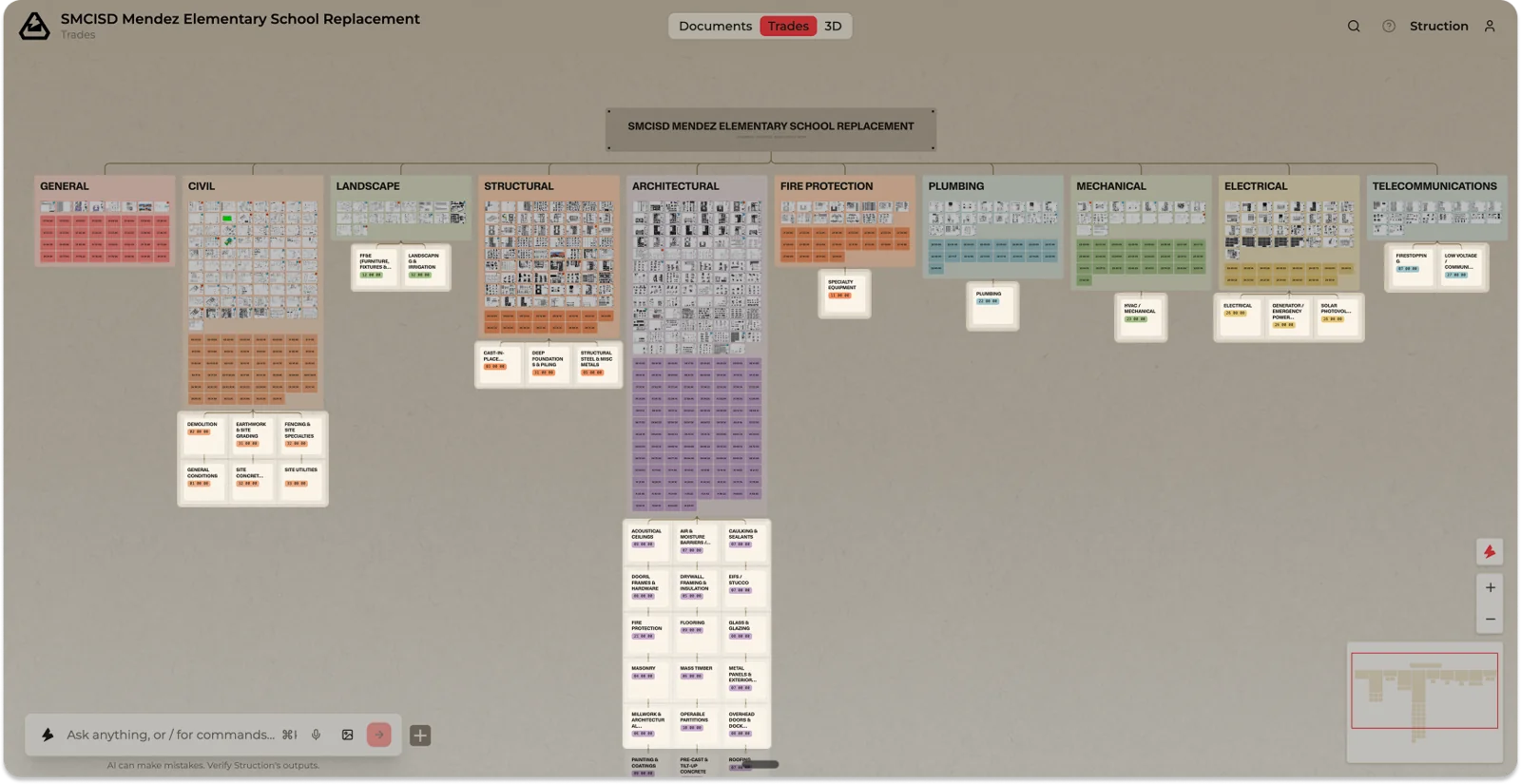
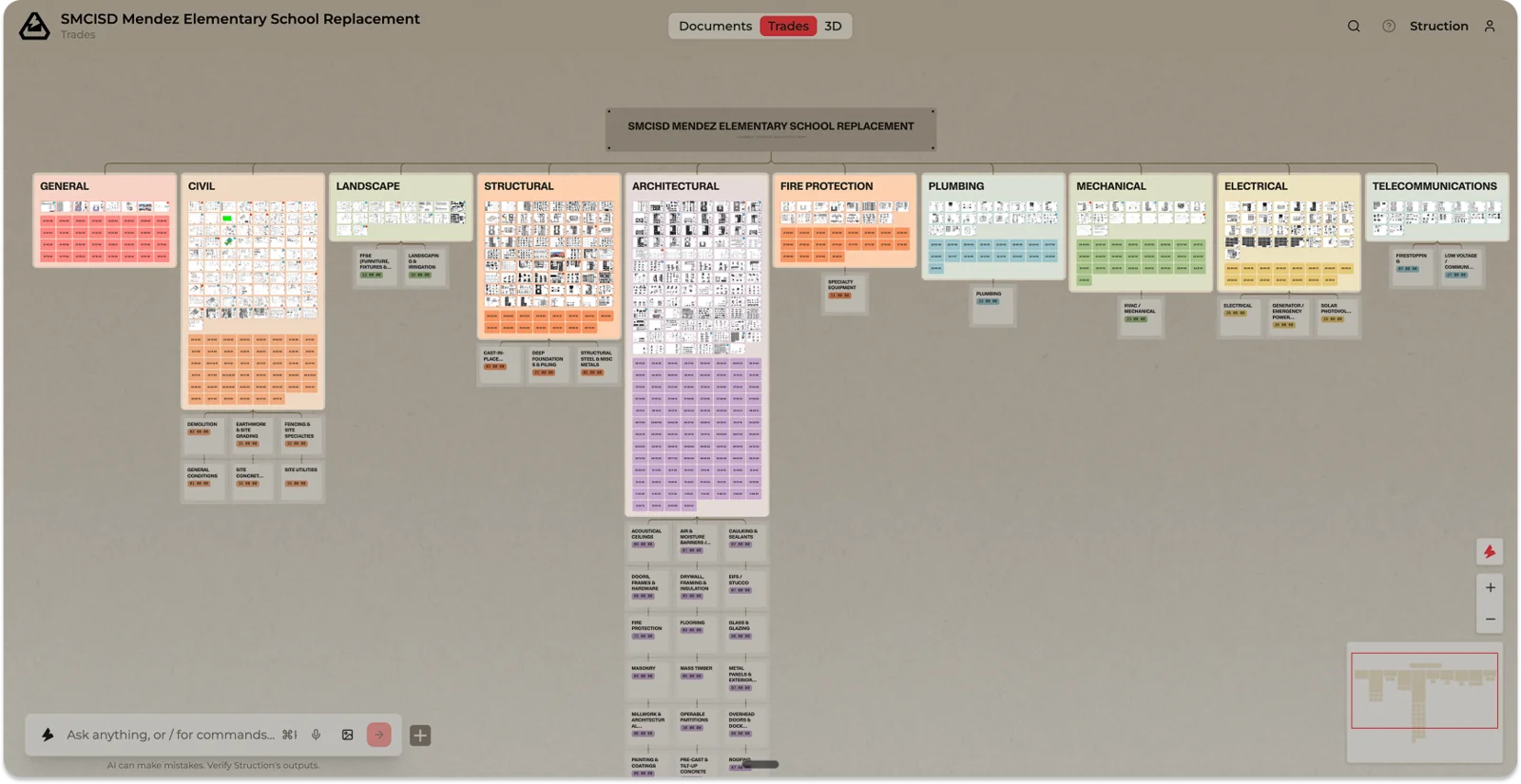
Struction assumes the architect and engineers have broken the project's requirements into disciplines, and that your job is to define the scopes that fulfill them. So it produces a first draft of those scopes, then flags the risks, RFIs, and gaps that come with them.
From any project, you get three kinds of output:
- Scopes of Work — your trade-by-trade bid forms. See Scopes of Work.
- Issues — RFIs, risks, and scope gaps to resolve before bid day. See Issues.
- Quantities — measurements taken off the drawings to back your pricing. See Quantity Takeoff.
Today, Struction helps you do five jobs: discovery (understanding a new project), scope creation, RFI creation, risk resolution, and quantity takeoff.
Tip — Senior and junior estimators use Struction the same way; the difference is scope of responsibility, not workflow. A junior estimator might own one discipline, a senior estimator the whole map — and you can collaborate on the same map.